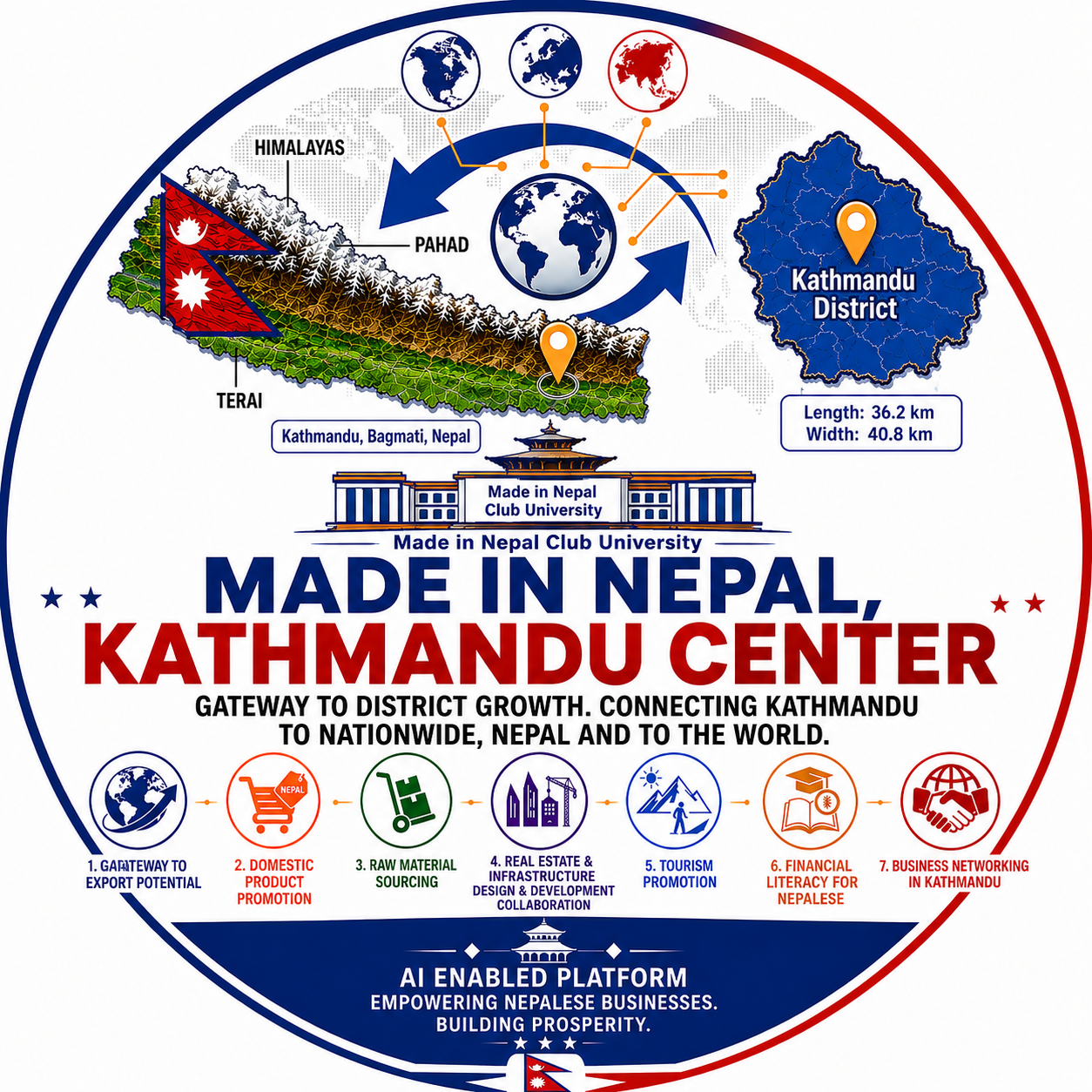
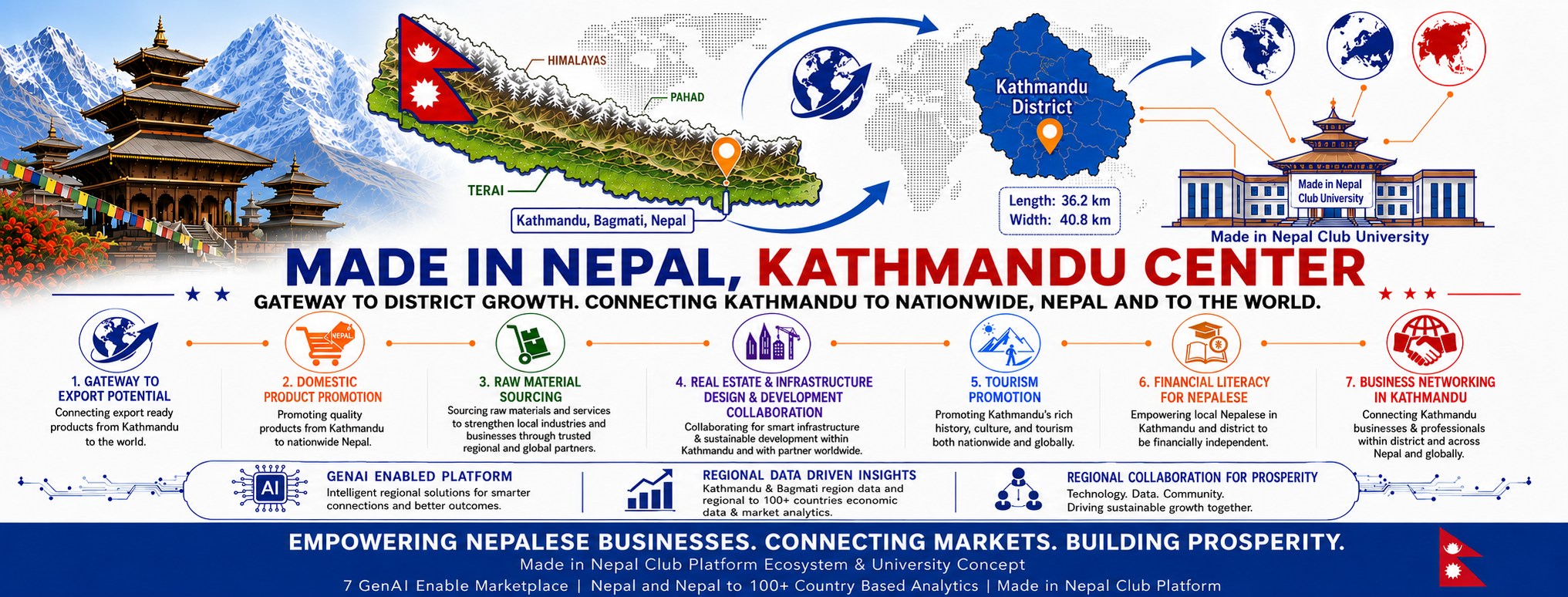
Kathmandu Economic Gateway
Gateway to Export Potential, Domestic Product Promotion, Raw Material Sourcing, Real Estate & Infrastructure Design & Development Collaboration, Tourism Promotion, Financial Literacy for Nepalese & Business Networking in Kathmandu, Nepal and to the world.
The Federal Capital, Financial Engine & High-Value Knowledge Hub of Nepal
Kathmandu District stands as the absolute economic nerve center, sovereign administrative hub, and primary service-consumption driver of Nepal. It coordinates high-value technology outsourcing clusters, central financial institutions, specialized processing industries, and international diplomatic pipelines. With an unmatched density of corporate enterprises, advanced educational hubs, and cross-border commercial links, Kathmandu coordinates the aggregation of national products and knowledge-based services, projecting capital region innovation directly into the global trade stream.
Operational Philosophy: This system uses a centralized architecture managed by a single technology operator, utilizing shared cloud infrastructures, standard relational database indexing, and strict sequential gateway milestones. By avoiding isolated, non-integrated marketing campaigns, every data layer is combined to increase localized capital efficiency and limit platform sprawl.
Seven Integrated Global Architectures
Every specialized platform interface must successfully clear three mandatory operational filters: generating verified measurable localized district value, offering scalable countrywide replication frameworks across Nepal, and establishing definitive structural authority for global buyers, institutional investors, and diaspora networks.
Market Research and Feasibility Study On: exportfromnepal.visitktmnepal.com
Gateway to Export Potential: Organizing export-readiness protocols, harmonized HS code registries, and quality standardization frameworks for software engineering outputs, premium pashmina textiles, hand-knotted carpets, and boutique metalcrafts. Prior to international outreach, the network maps international data safety regulations, country-of-origin standards, and cross-border payment compliance systems.
Market Research and Feasibility Study On: hamrosaman.visitktmnepal.com
Domestic Product Promotion: Constructing the preeminent capital-region digital marketplace to display urban startup innovations, FMCG brands, premium valley dairy outputs, and creative small-to-medium enterprise designs. The system leverages verified localized vendor profiles, transparent wholesale pricing metrics, and reliable logistics networks to catalyze domestic retail and institutional volume.
Market Research and Feasibility Study On: formadeinnepal.visitktmnepal.com
Raw Material Sourcing: Optimizing B2B logistics networks by matching capital-area processing clusters, garment manufacturers, and handicraft units directly with reliable domestic primary material suppliers across other federal districts. Focus areas include lifecycle cost optimization, raw supply forecasting, and a transition pathway toward robust regional sourcing based on immediate plant requirements.
Market Research and Feasibility Study On: visithimalpahadterai.visitktmnepal.com
Tourism Promotion: Designing fully bookable geo-targeted travel circuits that connect regional pilgrims, global travelers, and business professionals to Kathmandu's landmarks. Key focuses include structural paths around the seven UNESCO World Heritage sites, MICE business travel corridors, luxury hospitality assets, and ridge-line eco-trails along the valley rims.
Market Research and Feasibility Study On: egharjagga.visitktmnepal.com
Real Estate & Infrastructure Design & Development Collaboration: Developing an exclusive project platform for smart city urban planning models, optimized commercial high-density complexes, technology park architectural layouts, and advanced transit-oriented zoning setups. The architecture strictly isolates public marketing presentations from independent engineering validations and formal structural reviews.
Market Research and Feasibility Study On: finguru.visitktmnepal.com
Financial Literacy for Nepalese: Engineering highly structured bilingual educational frameworks deployed via text, interactive media, and voice interfaces in Nepali and local languages. Curriculums explicitly address digital banking security, trade financing structures, institutional investment pathways, corporate taxation practices, and the allocation of remittances into formal productive investment channels.
Market Research and Feasibility Study On: connectingnepali.visitktmnepal.com
Business Networking: Unifying commercial actors, chambers of commerce, technology innovators, and manufacturing hubs across the capital region into a single framework. The platform organizes verified matchmaking indices, international buyer-seller introductions, virtual diaspora consultation tracks, and annual trade summits. Success is evaluated strictly on recorded commercial transactions rather than passive web traffic metrics.
Quantitative Execution Timeline
Conform baseline data maps across 120 processing installations and 50 agricultural cooperatives; onboard 200 certified business profiles; document 30 target export-ready item streams; compile local letters of intent from regional commerce entities.
Launch centralized regional B2B relational directory models; execute three domestic trade promotions and two cross-border matching missions; initiate monthly financial literacy modules; target Nrs 6.5m (USD 42,910) platform corporate membership revenue lines.
Extend deep architecture integrations throughout Bagmati province networks; connect directly with global procurement channels; secure 1,000+ verified enterprise directory profiles, tracking 120+ transactions.
Mandatory Go/No-Go Gate Criteria: Immediately pause secondary system development if fewer than 200 corporate entities complete verified auditing profiles, fewer than 40 trade partners commit formal operational letters, less than 30% of platform trade leads convert into qualified transactions, or Year-1 tracked membership revenue falls short of Nrs 6.5m (USD 42,910).
Recommended Allocation Architecture: Total initial capital requirement is calculated at Nrs 16,000,000 (USD 105,624). This is structurally deployed as: Nrs 8,000,000 (USD 52,812) for core platform infrastructure, data collection, compliance auditing, and brand rollout; Nrs 6,000,000 (USD 39,610) reserved to cover Year-1 working deficits; and Nrs 2,000,000 (USD 13,203) held as an insulated buffer contingency fund.